
Timber vs Aluminium Windows: Which Is Better for Sydney Homes?

If you own a home in Sydney and you’re looking at your windows, you’ve probably asked this question: should I stick with timber or switch to aluminium? It’s not a simple answer. Both materials have real advantages and the wrong choice can cost you money, affect your home’s look, and even impact its value.
This guide breaks down timber vs aluminium windows in plain language. We’ll cover cost, energy efficiency, maintenance, looks, and what makes sense for Sydney’s climate. Whether you have a heritage Federation home or a modern terrace, this will help you make the right call.
The Basic Difference Between Timber and Aluminium Windows
Timber windows are made from wood usually pine, cedar, or hardwood. They’re what you’ll find in most homes built before the 1980s in Sydney, particularly in suburbs like Balmain, Leichhardt, Glebe, and Paddington.
Aluminium windows are made from a metal frame with a glass pane. They became popular in Australia from the 1970s onwards, mainly because they’re affordable and low maintenance.
At a glance:
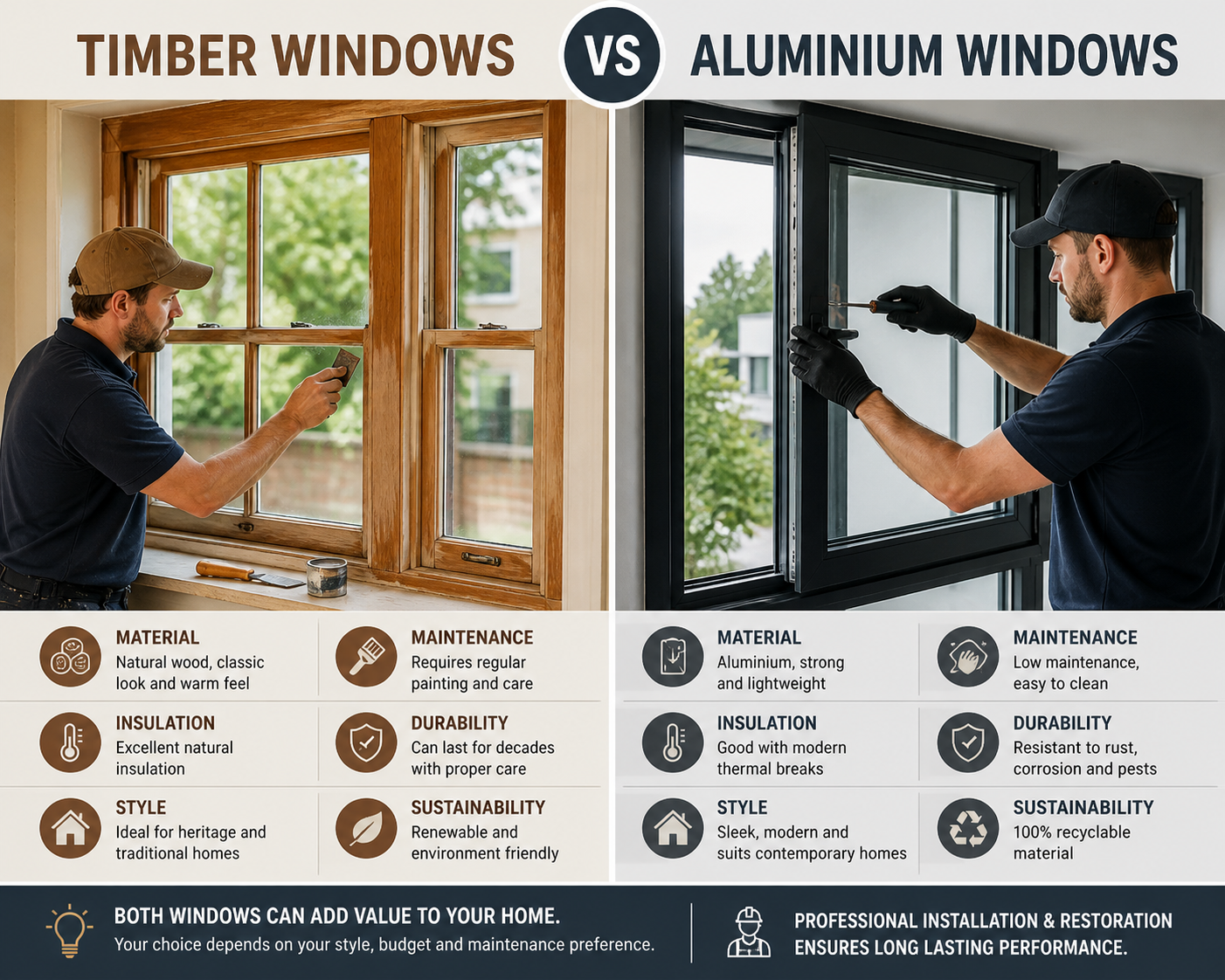
Feature | Timber | Aluminium |
Material | Natural wood | Metal alloy |
Common in | Pre-1980s homes | Modern builds |
Look & feel | Warm, classic | Sleek, modern |
Average lifespan | 50–100+ years (with care) | 20–40 years |
Maintenance | Moderate | Very low |
Insulation | Excellent | Poor (unless thermally broken) |
Cost to replace | $800–$2,500+ per window | $400–$1,500 per window |
How Do Timber Windows Perform in Sydney’s Climate?
Sydney has a humid, coastal climate with hot summers and mild winters. You might think timber wouldn’t hold up well but properly maintained timber windows actually perform beautifully here.
- Natural insulation: Timber is a poor conductor of heat. That means less heat gets in during summer and less warmth escapes in winter. Your air conditioning doesn’t have to work as hard.
- Noise reduction: Timber frames absorb more sound than aluminium. If you’re near a busy road, this matters.
- Moisture resistance (when sealed properly): Yes, timber can swell or rot but only if it’s not maintained. A well-sealed timber window handles coastal humidity just fine.
- Expansion and contraction: Wood naturally moves a little with temperature changes. This is normal, and it’s why draught proofing and proper sealing are important.
The key takeaway: timber windows don’t fail because of the climate. They fail because of neglect.
How Do Aluminium Windows Perform in Sydney?
Aluminium is the go-to for modern builds because it’s durable and doesn’t need painting. But it has some real limitations, especially in older homes.
- Conducts heat and cold: Standard aluminium frames transfer temperature easily. In summer, frames can get hot to the touch. In winter, they contribute to draughts and cold spots.
- Condensation issues: Because aluminium gets cold quickly, you can get condensation build-up on the inside of the frame. Over time, this can damage walls and sills.
- Limited insulation value: Unless the frame has a thermal break (a rubber insert that stops heat transfer), aluminium windows don’t insulate well.
- Long lasting with zero fuss: On the upside, aluminium doesn’t rot, warp, or need repainting. Once it’s in, it’s mostly hands-off.
Cost Comparison: Timber vs Aluminium Windows in Sydney
Cost is often the deciding factor but it’s worth looking at the full picture, not just the upfront price.
New Replacement Windows
Cost Factor | Timber Windows | Aluminium Windows |
Supply & install (per window) | $800–$2,500+ | $400–$1,500 |
Heritage-grade timber | $2,000–$4,000+ | N/A |
Custom sizing | Higher cost | Moderate cost |
Ongoing maintenance (per year) | $50–$200 approx. | Minimal |
Window Restoration vs Replacement
Here’s something many Sydney homeowners don’t know: restoring your existing timber windows is almost always cheaper than replacing them.
- Timber window restoration: $300–$900 per window (depending on condition and work required)
- Full timber replacement: $800–$2,500+ per window
- Switching to aluminium: Often $400–$1,500 per window, but you lose insulation value and heritage character
If your timber windows are structurally sound, restoration gives you the best outcome for the least money. Sash Masters specialises in timber window restoration across Sydney and can give you an honest assessment of whether repair or replacement makes more sense for your home.
Is It Better to Repair or Replace Timber Windows?
Repair or replace? This is the question we hear most often from Sydney homeowners. Here’s the honest answer:
Restore your timber windows if:
- The frames are structurally intact (no serious rot through the core)
- You have a heritage-listed property (replacement may not be permitted)
- You want to preserve the original character and value of the home
- The windows are sticking, rattling, or draughty these are fixable problems
- You want a cost-effective solution
Replace your windows if:
- The timber is severely rotted beyond repair
- The frames are beyond structural recovery
- You’re doing a full renovation and want a modern look throughout
- The windows are custom sizes that are no longer available
In our experience working on homes across Sydney, most windows that homeowners think need replacing just need a proper restoration. Stuck sashes, draughts, rattling panes, flaking paint these are all fixable without ripping out the whole window.
What About Heritage Properties in Sydney?
If your home is heritage-listed or even in a heritage conservation area this changes everything.
In many Sydney council areas, you’re not allowed to simply swap original timber windows for aluminium ones. Councils like the City of Sydney, Inner West, and North Sydney have specific rules around window materials, glazing, and style in heritage zones.
What this means for you:
- You may need council approval before replacing windows
- Replacing timber with aluminium could be refused or require reversal at your cost
- Restoring existing windows is almost always the approved path
- Heritage window restoration maintains authenticity and keeps your approvals simple
Sash Masters has extensive experience with heritage window restoration across Sydney. We understand the council requirements and can work with what you have rather than pushing for unnecessary replacements.
The Timber Window Restoration Process: What Actually Happens
If you’ve never had windows professionally restored, you might be wondering what the process looks like. Here’s a straightforward breakdown:
Step-by-step restoration process:
- Inspection — assess condition of frames, sashes, glazing, and hardware
- Paint removal — strip old paint layers (safely, including lead paint management if needed)
- Timber repair — fill or replace any sections of rot or damage
- Rebalancing sashes — adjust weights, cords, and pulleys so windows open and close smoothly
- Draught sealing — install weatherstripping and seals to stop draughts and improve energy efficiency
- Glazing upgrades — re-glaze or upgrade to double glazing where applicable
- Final painting and finish — repaint to a professional standard, ready to last years
Most single-window jobs take 1 day. Larger projects or full houses are typically completed over 2–5 days depending on scope.
Common Problems with Timber Windows (and How They’re Fixed)
Timber windows develop predictable problems over time. The good news is that almost all of them are fixable without replacement.
- Stuck or hard to open: Usually caused by paint build-up or swelling from moisture. Stripped back and rebalanced, they’ll operate smoothly again.
- Draughts coming through: The gap between the sash and frame needs proper draught-proofing seals. This is a straightforward fix that also cuts energy bills.
- Rattling in the wind: Sash cords may be worn or the window may have settled. New cords and minor adjustments fix this.
- Rot in the frame or sill: If caught early, rot is repaired by cutting out the affected timber and filling with specialist repair compound or splicing in new timber.
- Flaking or peeling paint: Old paint (especially lead-based paint on older Sydney homes) needs proper stripping and repainting. This is part of a standard restoration.
- Broken or cracked glass: Panes can be re-glazed or upgraded. If you want better insulation, this is the ideal time to look at secondary glazing options.
🏠 Who Should Consider Timber Window Restoration? ✓ Owners of homes built before the 1980s with original timber windows ✓ Heritage property owners where replacement isn’t permitted ✓ Anyone dealing with draughts, rattling, or stuck sash windows ✓ Homeowners who want to improve energy efficiency without full replacement ✓ People preparing to sell and want to present windows in the best condition |
Common Mistakes to Avoid with Window Restoration
- Painting over rot: Covering rotted timber with paint just hides the problem. It will get worse underneath and cost more to fix later.
- Using the wrong paint: Exterior timber needs exterior-grade paint with good flexibility. Interior paint on an outdoor window will fail quickly.
- Ignoring draught proofing: Restored windows without proper seals will still let in draughts and noise. should always Draught proofing be part of the job.
- DIY lead paint removal: Many Sydney homes built before 1970 have lead-based paint on their windows. Sanding or scraping this without proper precautions is a health hazard. Always use a professional.
- Assuming all timber windows need replacing: Most don’t. Get a professional assessment before writing off windows that can be saved.
Frequently Asked Questions
How much does timber window restoration cost in Sydney?
Most timber window restorations in Sydney cost between $300 and $900 per window, depending on the size, condition, and the work involved. This is significantly less than replacing windows entirely. Sash Masters can give you a clear quote after an initial inspection.
Are timber windows better than aluminium for energy efficiency?
Yes, in most cases. Timber is a natural insulator and doesn’t conduct heat the way aluminium does. A properly restored and draught-proofed timber window will outperform a standard aluminium window on energy efficiency. Thermally broken aluminium can close the gap, but at a much higher cost.
Can I replace timber windows with aluminium in a heritage area?
Not always. Many Sydney councils restrict changes to window materials in heritage zones or on heritage-listed properties. You may need development approval, and replacement with aluminium could be refused. It’s worth checking with your council before making any decisions. Heritage window restoration is usually the approved and more affordable path.
How long does sash window restoration take?
A single sash window typically takes one full day to restore properly. Larger jobs covering multiple windows or a whole house are usually completed within 2–5 days. The timeline depends on the scope of work, condition of the windows, and drying time for paint.
What services does Sash Masters offer in Sydney?
Sash Masters is a Sydney-based specialist in timber window and door restoration. Services include sash window repair, timber window restoration, heritage window restoration, window glazing upgrades, draught proofing, door restoration, and new window and door installation. We work across all Sydney suburbs.
The Bottom Line: Timber or Aluminium?
For most Sydney home owners especially those in older homes, heritage areas, or Federation-era suburbs, timber windows are the better long-term investment. They insulate better, last longer with care, and add genuine character and value to your home.
The real question isn’t always timber vs aluminium. Often, it’s restore vs replace. And for most homes, restoring existing timber windows is the smarter, more affordable choice.
If you’re dealing with stuck windows, rattling sashes, draughts, or just windows that look tired, don’t assume you need to replace them. A professional inspection will tell you exactly what’s needed and it might be much less than you think.